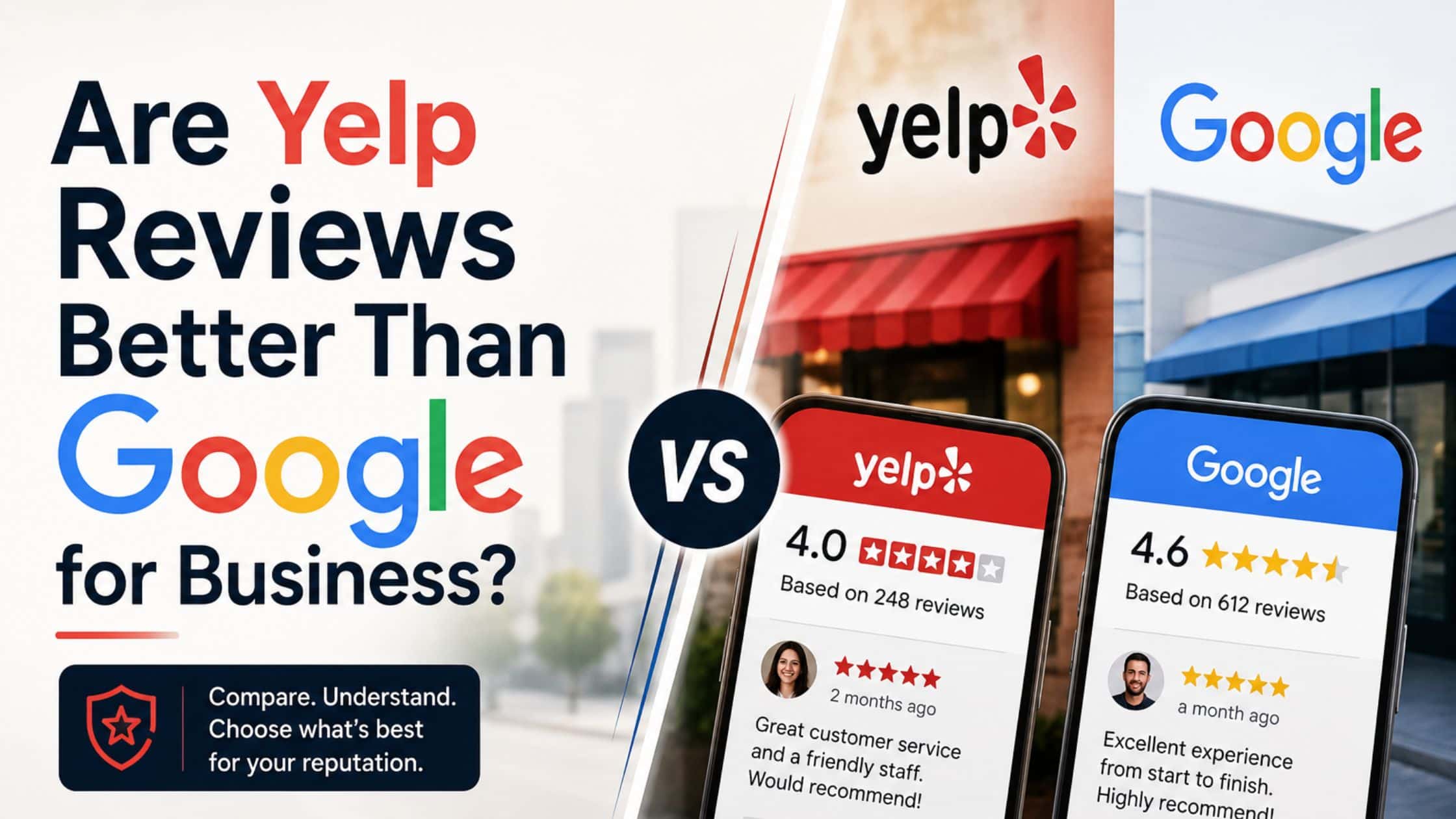
Business owners ask this question constantly and for good reason. Reviews on both platforms shape how customers find you, whether they trust you, and whether they spend money with you. The wrong answer costs real revenue.
Let’s compare Yelp and Google reviews across the factors that actually matter for your business, such as reach, audience, SEO impact, review quality, fraud protection, and how negative reviews are handled.
Yelp vs Google Reviews Comparison at a Glance
No. Google reviews outperform Yelp in reach and local SEO impact. However, Yelp drives higher-intent customers in restaurants and home services.
| Factor | Google Reviews | Yelp Reviews |
| Consumer reach | 83% of consumers check Google reviews | 44% of consumers check Yelp reviews |
| SEO impact | Direct ranking factor in the local pack | Indirect — Yelp pages rank on Google |
| Review volume | Very high (low friction to submit) | Lower (higher friction, stricter filters) |
| Review quality | Variable — often short | Higher — typically longer and more detailed |
| Audience income | Broad demographic | 54% earn over USD 100,000 per year |
| Purchase intent | Discovery-stage searchers | High-intent, active shoppers |
| Ability to solicit reviews | Yes — permitted with direct links | No — direct solicitation not allowed |
| Fake review filtering | Automated; less strict | Algorithm-based; stricter |
| Key industries | All local businesses | Restaurants, home services, health, beauty |
| Business tools | Google Business Profile (free) | Yelp for Business (free + paid options) |
The Scale Difference Is Significant
Google and Yelp operate at very different scales, and that gap has widened.
Google handles approximately 8.5 billion searches per day and holds around 88% of the global search market. According to a 2025 BrightLocal survey, 83% of consumers check Google reviews, compared to just 44% who check Yelp reviews.
Google also accounts for roughly 73% of all online reviews posted globally, while Yelp holds around 6% of the market, placing it second among review platforms ahead of Facebook and TripAdvisor.
Yelp is not small. The platform reached 330 million cumulative reviews as of December 31, 2025, with users contributing 22 million new reviews in 2025 alone. The platform sees over 178 million unique monthly visitors and hosts more than 265 million reviews worldwide.
But measured against Google’s reach and search integration, Yelp operates in a different tier.
For most businesses, more people will encounter your Google reviews first, often before they visit your website.
How Each Platform Affects Local SEO
This is where the difference between the two platforms becomes most concrete.
Google reviews directly influence your position in Google’s local pack, the map results that appear when someone searches for a local business or service. According to Whitespark and BrightLocal’s 2026 Local Search Ranking Factors report, Google Business Profile signals account for 32% of local pack ranking weight, and review signals account for 16%, together representing the two largest controllable ranking factors.
Businesses with 100 or more Google reviews rank 20% higher in local packs, according to Widewail’s 2025 research. Appearing in the Google 3-Pack yields approximately 126% more traffic and 93% more customer actions than positions 4 through 10 in local results.
Yelp reviews do not carry the same direct weight in Google’s algorithm. Yelp pages rank in Google’s organic results, so a strong Yelp profile can appear on the first page when someone searches your business name, giving you additional presence.
But Yelp reviews themselves do not feed into your Google Business Profile score or influence your local pack position.
Whitespark’s local SEO experts note that review signals extend beyond Google: the quantity of reviews on industry-specific sites, including Yelp and TripAdvisor, contributes indirectly to overall local authority.
For the most direct SEO impact, though, Google reviews are the clear priority.
The Audience Each Platform Reaches
The people on Yelp are not the same as the people on Google, and this distinction matters for some businesses more than others.
Google’s audience reflects the general population. Anyone with a Google account can leave a review, and the low barrier to entry means Google accumulates a higher volume but also greater variation in review quality.
Google controls over 89% of the mobile search engine market share, meaning most searches for local businesses start on Google.
Yelp’s audience is narrower but more defined. Almost 56% of U.S. Yelp users earn USD 100,000 or more annually, and around 87% hold a bachelor’s degree or higher. More than 80% of Yelp searches come from mobile devices, and 4 out of 5 Yelp users are ready to purchase when they visit a business page. Around 57% contact or visit a business within one day of searching on Yelp.
What this means in practice: Yelp users arrive with higher purchase intent and, on average, higher spending power.
For businesses targeting premium-priced services, fine dining, professional home services, health and wellness, legal, or financial services, the Yelp audience is a genuinely valuable segment. For businesses trying to reach the broadest possible customer base, Google’s reach is irreplaceable.
Review Quality and Depth
The reviews themselves differ in character across the two platforms.
Around 60% of Yelp reviews are three sentences or longer, making them richer than the average quick Google star rating. Yelp was built from the start around detailed, community-driven reviews.
Its users tend to invest more time in writing about their experiences, which produces content that other potential customers find informative and persuasive.
Google reviews tend to be shorter and more varied. The friction-free submission process, anyone with a Google account can leave a rating in seconds, sometimes prompted automatically after a visit detected via Google Maps, produces volume but not always depth.
A business might accumulate hundreds of Google reviews with minimal written content alongside a smaller number of detailed Yelp reviews.
For potential customers researching a significant purchase or booking, the quality of a Yelp review often provides more useful information. For quick decisions, the kind someone makes while searching on the go, a Google star rating and brief review summary is often enough.
How Each Platform Handles Fake Reviews
Fake reviews are a growing problem on both platforms, but the two systems approach the problem differently.
Yelp uses a proprietary recommendation algorithm that filters reviews before they contribute to a business’s star rating. Reviews from new accounts, accounts with limited review history, or accounts that have only ever reviewed one business are more likely to be moved to Yelp’s “Not Recommended” section.
Around 76% of all Yelp reviews are “recommended” by this filtering system, while the remaining 24% are filtered out as potentially low-quality or suspicious.
This algorithm is stricter than Google’s, and it cuts both ways. It filters genuine reviews from legitimate customers alongside suspicious ones, which frustrates business owners who lose positive feedback to the filter. On the other hand, it also removes more fake negative reviews automatically.
Google’s moderation system relies more heavily on automation and is generally more permissive at the point of submission. Approximately 11% of Google reviews may be fraudulent, according to available estimates. Google does take action on reported fake reviews, but the sheer volume of Google reviews makes comprehensive moderation harder.
For businesses facing coordinated fake review attacks, Yelp’s algorithm may catch more fraudulent content automatically. For businesses dealing with fake reviews that slip through, both platforms offer manual reporting with varying success rates.
How Easy It Is to Get Reviews on Each Platform
There is a significant difference in how business owners can ethically encourage customers to leave reviews.
Google explicitly allows businesses to ask customers for reviews. You can generate a direct review link from your Google Business Profile dashboard, share it via email, SMS, or display it as a QR code, and invite any customer to use it.
Google’s policies permit direct solicitation as long as you do not offer incentives or filter who receives the request.
Yelp discourages businesses from directly asking customers for reviews, and doing so may violate Yelp’s terms of service. Instead, Yelp suggests displaying Yelp stickers, badges, or mentioning “Find us on Yelp” without specifically requesting a review.
This policy difference has a direct impact on review volume. Businesses that actively collect Google reviews through direct requests often build their review count much faster than their Yelp equivalent. Yelp reviews accumulate more organically, driven by motivated reviewers rather than direct business solicitation.
The practical implication: building a Google review profile is faster and easier for most businesses. Growing a Yelp profile requires patience and a strong customer experience that motivates reviewers to seek the platform out independently.
Industries Where Yelp Carries More Weight
While Google reviews matter more for most businesses by reach and SEO impact, Yelp holds an outsized influence in specific industries.
1. Restaurants and food businesses
Yelp was originally built around restaurant discovery. Many diners, particularly in metropolitan areas, treat Yelp as the primary source for checking a restaurant before booking.
The detailed photo-heavy reviews and filter options (price range, cuisine type, neighbourhood) serve this use case better than Google’s format.
2. Home services
Yelp’s “Request a Quote” feature makes it a transactional platform for plumbers, electricians, cleaners, and contractors.
Home and local services now generate 68% of Yelp’s total advertising revenue, reflecting how dominant this category has become on the platform.
3. Health, wellness, and beauty
Salons, spas, dental practices, and allied health providers find Yelp’s audience particularly well-matched to their customer profile.
4. Premium and professional services
Yelp’s affluent, highly educated user base aligns well with businesses that attract higher-spending customers and clients.
If your business falls into one of these categories, Yelp is not a secondary platform — it is a primary one for your specific audience.
The Role of Each Platform in Customer Decision-Making
Google and Yelp tend to reach customers at different moments in the decision process.
Google reviews meet customers at the discovery stage. Someone searches “dentist near me” or “plumber in [suburb]” and sees your Google Business Profile before any other content about your business. The star rating, review count, and review snippets visible in search results influence whether they click through. This happens at the very top of the decision funnel.
Yelp, by contrast, is more destination-based. Users specifically go to Yelp to read reviews and find businesses, and customers who use Yelp are often “high-intent,” meaning they are ready to buy and are looking for the right option.
This distinction matters for how you think about each platform. A weak Google presence means fewer people find your business at all. A weak Yelp presence means fewer high-intent customers convert. Both represent real revenue risk.
What Happens When Negative Reviews Appear
A negative review on either platform is damaging, but the exposure differs.
A negative Google review appears every time someone searches for your business name on Google. It sits inside your Google Business Profile, visible to anyone who encounters your listing in search results or Google Maps. The exposure is high and persistent.
A negative Yelp review reaches people who are already using Yelp to research businesses. Its audience is smaller but highly engaged. In some industries and locations, a cluster of negative Yelp reviews is the deciding factor for potential customers who specifically use the platform to vet businesses before booking.
On both platforms, fake or policy-violating negative reviews can be reported and removed. The process differs between the platforms, the success rate varies by the strength of your evidence, and neither guarantees removal.
On Yelp, 92% of consumers say negative reviews make them less likely to use a business. On Google, the impact on individual decisions is less precisely documented but substantial, particularly for businesses that compete in the local pack where star ratings are visible at a glance.
For businesses targeted by fake or defamatory reviews, the appropriate response is the same on both platforms: report the review through the platform’s official channels with supporting evidence, respond professionally to any review you cannot immediately remove, and focus on building a stronger review profile overall.
Yelp vs Google Reviews – Which Platform Should You Prioritise?
For most businesses, Google reviews come first. The reach is greater, the SEO impact is more direct, and you can actively ask customers to leave reviews. If you have limited time, start with Google.
If your business is a restaurant, home service provider, health or wellness business, or premium service, Yelp is equally important for your specific audience. In those categories, a strong Yelp profile is not optional; it is a competitive necessity.
The most effective strategy combines both. Maintain an optimised Google Business Profile, actively collect Google reviews, and keep your Yelp listing accurate and responsive, even if you cannot directly solicit Yelp reviews.
What neither platform can absorb is significant fake review damage. Fake reviews on either platform need to be dealt with directly, through reporting, professional responses, and, where necessary, specialist removal support.
Dealing with Fake Reviews on Yelp, Google, or Both?
Fake reviews are one of the most damaging threats to a business’s online reputation, and they appear on both platforms.
At ReviewFix, we help Australian businesses identify and remove fake, defamatory, and policy-violating reviews on Google, Yelp, TripAdvisor, and beyond. Our team builds evidence-backed removal cases and manages the entire reporting process on your behalf.
If your star rating is being dragged down by reviews from people who were never your customers, you do not have to accept it.
Visit our Fake Review Removal page to find out how we can help your business.
Frequently Asked Questions
Q. Do Yelp reviews help Google rankings?
Not directly. Yelp reviews do not feed into your Google Business Profile rating. However, a strong Yelp page can rank in Google search results for your business name, giving you more visibility on the first page. Yelp reviews may also contribute indirectly to local authority signals.
Q. Is it better to have more Google reviews or Yelp reviews?
More Google reviews are generally more valuable for search visibility. Google reviews directly influence your local pack position. That said, review volume on Yelp matters for businesses in industries where Yelp is a primary discovery tool.
Q. Can a business ask customers to leave Yelp reviews?
Not directly. Yelp prohibits direct solicitation. You can display Yelp signage and mention the platform without specifically asking for reviews. Direct requests for Yelp reviews can trigger Yelp’s algorithm to filter those reviews as suspicious.
Q. Are Yelp reviews more trusted than Google reviews?
Both platforms are trusted, but for different reasons. Yelp reviews tend to be more detailed and come from a more engaged reviewer community. Google reviews are more widely read simply because more people use Google. Neither is definitively more trusted — they serve different audiences.
Q. What should I do about a fake review on Yelp or Google?
Report it through the platform’s official review reporting system with as much supporting evidence as possible. On Yelp, use the Management Centre to flag the review. On Google, report it through your Google Business Profile. If your reports are rejected or you are facing multiple fake reviews, professional support significantly improves removal outcomes.
Q. Does Yelp or Google have better fake review protection?
Yelp’s recommendation algorithm is stricter and filters more reviews automatically, which catches more suspicious content before it appears. Google moderation removes large volumes of fake reviews but is less strict at the initial posting stage. Both platforms require active reporting for reviews that slip through.