A harmful Google search result can damage your reputation, business, or privacy. It may show false information, outdated content, personal data, fake reviews, or unwanted images. Many people search for ways to remove these results quickly.
Google does not control every website on the internet. Most search results come from third-party websites. Because of this, Google removes search results only in certain cases. Still, there are proven ways to remove or reduce harmful content from Google Search.
To remove a search result from Google, request removal from the website owner first. If it violates Google policies, submit a Google removal request or use the outdated content removal tool.
What Does It Mean to Remove a Google Search Result?
Google search removal means removing a page, image, or link from Google Search results. The content may still exist on the original website, but users will not easily find it through Google.
There are two common types of removal. The first involves removing the content directly from the website where it appears. The second involves removing the search result from Google itself. In most cases, removing the content from the source website is the most effective option.
Common Reasons People Remove Search Results
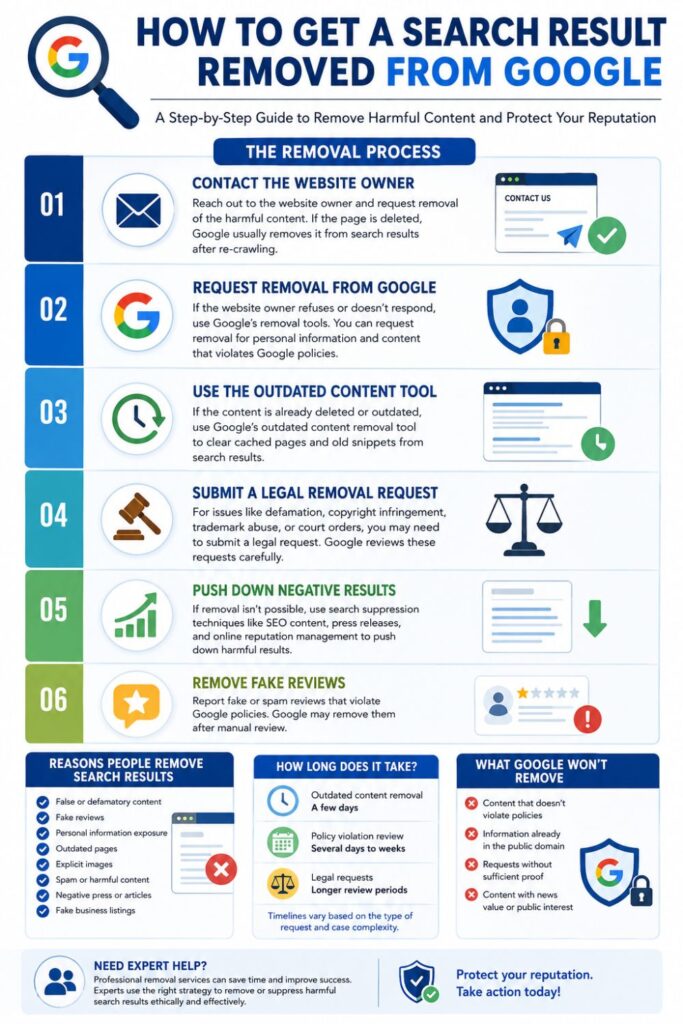
People request removal for many reasons. Some want to remove false or defamatory content that harms their reputation. Others want to delete fake reviews, personal information, explicit images, outdated pages, or spam content. Businesses also request the removal of negative press articles, fake business listings, and harmful search results that affect customer trust.
Can Google Remove Search Results?
Yes, Google can remove certain search results if they violate Google policies or legal standards.
Google may remove results that expose personal information such as phone numbers, addresses, bank details, or identity documents. It may also remove non-consensual explicit content, fake pornography, malware pages, phishing websites, copyright violations, and court-ordered removals. However, Google usually does not remove content simply because it is negative or embarrassing.
Steps to Get a Search Result Removed From Google
Step 1: Contact the Website Owner
This is the first and most effective step.
If the harmful content exists on another website, contact the website owner and request removal. Once the content is deleted from the source page, Google usually removes the search result automatically after re-crawling the page.
You can reach website owners through contact forms, email addresses, WHOIS records, or social media pages. Keep your message short and professional. Clearly explain why the content should be removed.
Step 2: Request Removal From Google
If the website owner refuses to remove the content or does not respond, you can submit a removal request directly to Google.
Google provides different removal tools for different situations. For example, Google may review requests involving exposed personal information such as phone numbers, email addresses, home addresses, financial details, or identity documents. These requests usually go through a manual review process.
Step 3: Use the Google Remove Outdated Content Tool
Sometimes the content no longer exists on the website, but Google still displays it in search results.
In this situation, you can use Google’s outdated content removal tool. This tool helps remove cached pages, outdated snippets, and deleted images from Google Search.
This method works well for deleted pages, updated articles, old business information, and removed images that still appear in search results.
Step 4: Submit a Legal Removal Request
Some cases require legal action.
You may need to submit a legal request for issues involving defamation, copyright infringement, trademark abuse, privacy violations, or court orders. Google reviews legal requests carefully before deciding whether to remove the content from search results.
How Long Does Google Removal Take?
The timeline depends on the type of request and the complexity of the case.
Outdated content removals may take only a few days. Policy violation reviews often take several days or weeks. Legal requests may require longer review periods because Google checks supporting evidence carefully before making a decision.
Why Some Search Results Stay Online
Google may reject removal requests for several reasons.
The content may not violate Google policies, the information may already be public, or the request may lack proper evidence. In some situations, Google may keep the content online because it has news value or serves public interest. This often happens with news articles, public records, and review platforms.
How to Push Down Negative Search Results
If removal is not possible, search result suppression can help reduce visibility.
Suppression works by improving positive content, so harmful pages move lower in Google results. Businesses often use SEO content creation, press releases, business profile optimization, authority backlinks, social media optimization, and review management to improve positive search visibility.
This approach helps businesses regain control of their online reputation.
Can Fake Reviews Be Removed From Google?
Yes, fake Google reviews can often be removed if they violate Google policies.
Google may remove reviews linked to spam, competitor attacks, fake engagement, hate speech, or off-topic content. In many cases, Google reviews these reports manually before taking action.
Professional Search Result Removal Services
Many removal cases become difficult without expert support. Some websites ignore requests, while others require legal handling or advanced SEO suppression methods.
Professional removal services help individuals and businesses remove harmful search results, fake reviews, negative articles, unwanted images, and exposed personal information. Experienced specialists can identify the best removal strategy and improve the chances of success.
Real Customer Experiences With Google Search Result Removal
Many people struggle to remove harmful Google search results without expert help. Some websites ignore requests, while others require advanced removal methods.
One business owner contacted us after a fake article damaged their company reputation in Google Search. Our team reported policy violations, contacted the website owner, and improved positive search visibility. Over time, the harmful result lost rankings and positive content moved higher.
Another client wanted to remove personal information that appeared in Google Search results. After direct website requests and Google privacy removal submissions, several harmful search listings were removed.
We also helped a local business remove fake Google reviews that affected customer trust. After reporting spam reviews and improving the business’s online reputation, the company regained stronger search visibility and customer confidence.
These experiences show that the right removal strategy can improve the chances of success.
How ReviewFix Helps Remove Harmful Google Search Results
ReviewFix Australia helps individuals and businesses remove harmful online content and improve their online reputation.
Our team helps clients remove fake Google reviews, suppress damaging search results, report fake content, remove harmful images, and repair online reputation issues. We use ethical methods that follow Google policies and accepted industry practices.
Key Takeaways
A harmful Google search result can affect trust, sales, and personal reputation. Fast action improves the chance of successful removal.
Start by trying to remove the content from the original website. If that fails, submit the correct Google removal request. If the case becomes difficult, professional help can save time and reduce stress.
The right strategy can remove harmful search results or reduce their visibility in Google Search.