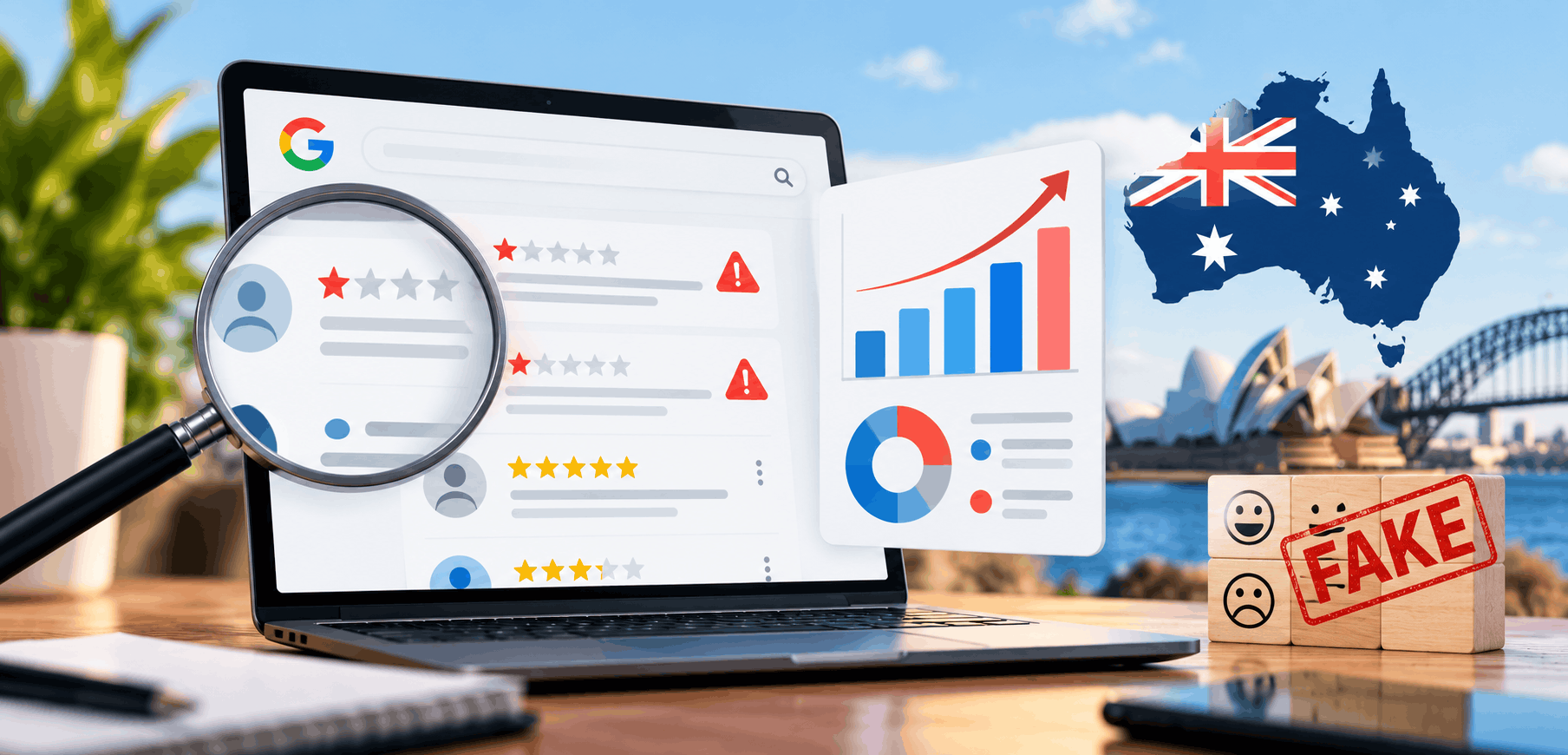
Online reviews influence where Australians spend their money. Most customers read them before making a purchase; thus, the data quality underlying those star ratings has a direct impact on real-world business outcomes. The problem is that a huge percentage of those reviews are fake – and the numbers are increasing.
At ReviewFix, we closely track fake review trends. This article pulls together the most current statistics on fake reviews in Australia, how the law treats them, and what businesses can do when fake reviews appear on their profiles.
How Many Australians Read Reviews Before They Buy?
The review economy in Australia is large.
- 82% of Australians have looked at online reviews or ratings at least sometimes over the last 12 months.
- More than 80% of Australians seek out product reviews before a purchase.
- Over 90% of Australian shoppers read online reviews as part of their research process.
- Over 65% of purchasing decisions are influenced by online reviews.
- 60% of Australians say a negative review influences their decision to purchase from a supplier.
When this many purchase decisions flow through reviews, the integrity of those reviews matters enormously. Fake reviews distort that process at scale.
How Many Reviews Are Fake?
The global benchmark sits at roughly 30%.
Roughly 30% of all online reviews are fake, and 82% of consumers encounter them annually.
That figure holds across multiple independent studies. On average, 30% of all online reviews are considered fake or inauthentic, and 46% of detected fake reviews carry 5-star ratings.
Five-star ratings are the most commonly manipulated. Fake positives push ratings up. Fake negatives pull competitor ratings down. Both tactics appear in the Australian market.
The Cost of Fake Reviews
Fake reviews are not a minor inconvenience. They redirect real spending toward businesses that do not deserve it.
Fake reviews are projected to cost consumers an estimated $787 billion globally in 2025 due to misleading purchases.
At a business level, the incentive to manipulate is strong. The FTC estimates that businesses buying fake reviews can see a return on investment as high as 1,900%, which explains why the practice persists despite the risks.
That return creates a competitive disadvantage for businesses that play by the rules. An honest competitor sitting at 4.1 stars loses customers to a dishonest one at 4.8 — even when the underlying quality is reversed.
Key Fake Review Statistics for Australia
| Statistic | Figure | Source |
| Australians who read reviews before purchase | 80–90% | APO / Bazaarvoice / Bandt |
| Share of all online reviews that are fake | ~30% | Shapo / Capital One Shopping |
| Fake reviews that carry 5-star ratings | 46% | Transparency Company / Capital One Shopping |
| Google reviews removed for violations (2023) | 170 million | Google Transparency Report |
| Trustpilot fake reviews removed (by 2024) | 4.5 million | Trustpilot Transparency Report |
| AI-generated share of detected fake reviews (2025) | 30%+ | Transparency Company |
| Maximum ACL penalty per breach — corporation | $1.1 million | Competition and Consumer Act 2010 |
| Maximum ACL penalty per breach — individual | Up to $500,000 | Competition and Consumer Act 2010 |
| Projected consumer cost of fake reviews (2025) | $787 billion | Shapo, 2025 |
Platform-Specific Data
Fake reviews appear on every major platform. The numbers below show the scale of the problem across the platforms most used by Australian consumers.
In 2023, Google blocked or removed 170 million policy-violating reviews — a 45% increase from the previous year. It also took down 12 million fake business profiles.
Despite those removals, policy-violating reviews continue to appear on Australian business listings every day.
Trustpilot
By 2024, Trustpilot had removed 4.5 million fake reviews, with 90% of them taken down automatically by AI detection tools.
TripAdvisor
TripAdvisor blocked 2 million fake reviews in 2023, accounting for 6.3% of all submissions. That represented a 50% increase in removals from 2022.
These platforms invest heavily in detection. Yet millions of fake reviews still get through each year.
The AI-Generated Review Problem
The most significant development in fake reviews over the last three years is AI generation. Reviews that once required a paid human writer can now be produced at near-zero cost and at scale.
The overall scale:
More than 30% of detected fake reviews in 2025 were AI-generated, according to a Transparency Company language-model detection audit.
DoubleVerify recorded a threefold increase in apps with AI-powered fake reviews in 2024 compared to 2023, and identified one streaming app where 50% of reviews were fake.
Industry-specific examples:
The rate of AI-generated personal trainer reviews rose from 11.7% in 2023 to 27.3% in 2025. More than 1 in 4 personal trainer reviews is now likely AI-generated.
AI-generated real estate agent reviews on Zillow increased by 558% from 2019 to 2025, reaching 23.7% of all reviews in 2025.
AI-generated Airbnb reviews surpassed 10% in 2024, representing a 209% increase from 2020 levels.
AI-generated reviews are harder to detect visually because they read fluently and avoid the obvious errors that once made fakes easier to spot. Standard platform detection misses many of them. Detection tools that analyse language patterns find them at significant rates.
Australian Consumer Attitudes Toward Fake Reviews
Australian consumers are aware that fake reviews exist. Their response has been increasing scepticism and tighter scrutiny before purchase.
In 2025, 24% of consumers reported being confident they had spotted a fake review — up from 19% in 2024.
85% of Australian shoppers believe reviews older than three months are less relevant, and most shoppers read an average of 10 reviews before they feel they can trust a business.
That last figure matters. A business with 10 reviews is already being read in full. Any fake reviews in that set are being read too.
The Legal Position in Australia
Fake reviews are not just an ethical problem in Australia. They are against the law.
It is against the law for a business to create fake or misleading reviews, or to arrange for others to do so. These practices breach the Australian Consumer Law (ACL). Businesses or review platforms that do not remove or correct reviews they know are fake may also be in breach.
Penalties under the Australian Consumer Law:
- Maximum penalty for a body corporate: $1.1 million per breach
- Maximum penalty for an individual: $220,000 per breach (and up to $500,000 under certain false representation provisions)
(Source: Competition and Consumer Act 2010 (Cth); optometry.org.au / ACCC guidance)
Court cases involving fake reviews in Australia:
- Electrodry was found to have breached the ACL and ordered to pay a penalty of $215,000.
- Two Australia-based companies were fined a combined $125,000 for publishing fake testimonials — the ACCC’s first litigated outcome on the specific prohibition against fake testimonials under the ACL.
- In October 2022, the ACCC announced it would review at least 100 businesses as part of an internet sweep targeting fake or misleading online reviews and testimonials.
The ACCC treats fake reviews as a compliance priority. The fines above are not theoretical — they represent real penalties paid by real Australian businesses.
Who Posts Fake Reviews and Why?
Fake reviews come from several sources.
Competitors. A business posts fake negative reviews on a rival’s Google profile to lower its star rating and divert customers.
The business itself. A business posts fake positive reviews to inflate its rating, appear more established, or recover from genuine negative feedback.
Third-party services. Paid review farms — some based overseas — offer bulk reviews for a fee. These services are illegal under Australian law and put purchasing businesses at direct legal risk.
AI tools. Since 2022, automated tools can generate large volumes of plausible-sounding reviews in minutes. The cost barrier to running fake review campaigns has collapsed.
Which Industries See the Most Fake Reviews?
Certain industries attract disproportionate levels of fake review activity. In Australia, the highest-risk categories include:
- Healthcare — doctors, dentists, allied health professionals
- Legal services — law firms and individual practitioners
- Hospitality — restaurants, hotels, short-stay accommodation
- Trades — plumbers, electricians, locksmiths
- Real estate — agents and property managers
- Retail — e-commerce sellers
These are high-trust categories where reviews carry significant weight. That makes them a target for manipulation — and it makes genuine review integrity a real competitive advantage.
What Happens When a Business Receives a Fake Review?
The immediate impact is a drop in star rating and, depending on the content, reputational damage that appears directly in search results. For a business with fewer than 50 reviews, a single fake 1-star review can move the average rating by 0.1 to 0.2 stars — enough to push it below a competitor in Google Maps results.
The downstream effects include:
- Lost clicks from Google Maps results
- Lost calls from people who see the rating and do not engage
- Long-term ranking effects in local search
Fake reviews left unaddressed compound over time. The earlier a removal request goes in, the better.
How to Respond to Fake Reviews in Australia
Businesses in Australia have three main options when they receive a fake review.
1. Flag it directly on the platform. Every major platform- Google, Facebook, Yelp, TripAdvisor, Glassdoor — allows businesses to report reviews that violate content policies. Google’s reporting tool is accessible through Google Business Profile. The outcome is not guaranteed, and the process can take days or weeks.
2. Use the Australian Consumer Law. If a fake review causes measurable harm, the ACL provides a legal basis to act. The ACCC and state consumer protection agencies can pursue businesses that post or commission fake reviews.
3. Work with a professional removal service. ReviewFix operates on a no-win-no-fee model. We assess whether a review violates the platform’s policies, prepare and submit removal requests, and follow up when Google or another platform does not act on the initial flag. Our work is confidential.
If you have received a fake review and want to understand your options, contact ReviewFix or visit our Google review removal page.
Key Takeaways
Fake reviews are a structural problem in the Australian review ecosystem. They are widespread, increasingly AI-generated, illegal under Australian law, and actively enforced by the ACCC. For businesses, the risk runs both ways: receiving fake negative reviews from competitors, and being held liable for posting or commissioning fake positive ones.
The most practical step any business can take is to quickly pursue removal of reviews that violate platform policies, before the rating damage compounds.
ReviewFix handles that process on a no-win-no-fee basis. Start a removal request here.
This article was researched and written by the ReviewFix team. All statistics are sourced from publicly available studies, platform transparency reports, ACCC guidance, and academic research. ReviewFix is an Australian reputation management business specialising in the removal of policy-violating reviews from Google, Facebook, Glassdoor, Yelp, and TripAdvisor.